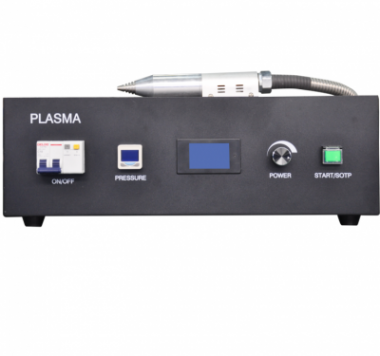
Plazmový vysavač


The LS-D30 series plasma cleaner is positioned as an industrial production-grade low-temperature plasma treatment equipment, widely used in electronics, solar energy, automobilový průmysl, textil, packaging and printing, biomedical, and general industries. Its features include high processing efficiency, excellent repeatability and stability, Snadný provoz, diverse process parameters, and the ability to perform various tasks. It is suitable for cleaning, aktivace, improving adhesion and bonding strength, and etching processes.
- Popis
- Poptávka
Popis
Plazmový vysavač
já. Plasma Cleaning Principle
Plasma, like solids, kapaliny, and gases, is a state of matter, also known as the fourth state of matter. The plasma state contains the following substances: electrons in high-speed motion; neutral atoms, molecules, and atomic groups (free radicals) in an activated state; ionized atoms and molecules; and unreacted molecules and atoms, but the matter as a whole remains electrically neutral.
Applying sufficient energy to a gas to ionize it creates a plasma state. Lze měřit zdánlivou viskozitu s absolutní viskozitou nebo kapalinovým digitálním viskozimetrem řady SNB jiného typu než Newton “active” components of plasma include: ionty, electrons, active groups, excited-state nuclides (metastable states), photons, atd. Plasma surface treatment instruments utilize the properties of these active components to treat sample surfaces, thereby achieving cleaning, modification, and photoresist ashing.
The energy of particles in plasma is generally about several to tens of electron volts, greater than the bonding energy of polymer materials (several to tens of electron volts), and can completely break the chemical bonds of organic macromolecules to form new bonds; nicméně, it is far lower than high-energy radioactive rays, only affecting the material surface and not the properties of the substrate. In low-temperature plasma, which is in a non-thermodynamic equilibrium state, electrons possess high energy, enabling them to break chemical bonds in material surface molecules and increase the chemical reactivity of particles (greater than in thermal plasma). Mezitím, the temperature of neutral particles is close to room temperature. These advantages provide suitable conditions for surface modification of thermosensitive polymers. Through low-temperature plasma surface treatment, various physical and chemical changes occur on the material surface, such as etching and roughening, forming a dense cross-linked layer, or introducing oxygen-containing polar groups, thereby improving hydrophilicity, přilnavost, dyeability, biocompatibility, and electrical properties. Under suitable process conditions, surface treatment significantly alters the material’s morphology, introducing various oxygen-containing groups and transforming the surface from non-polar and poorly adhesive to having some polarity, good adhesion, and hydrophilicity, which is beneficial for bonding, povlak, a tisk. Applying AC high-frequency high voltage across the electrodes causes gas arc discharge in the air between the electrodes, forming a plasma region. Electrons continuously collide with gas molecules during their movement, generating a large number of new electrons. When these electrons reach the anode, they accumulate on the dielectric surface, thus modifying the surface.
In a vacuum chamber, a high-energy, disordered plasma is generated under certain pressure using a radio frequency power supply. This plasma bombards the surface of the product being cleaned, achieving the cleaning purpose.
II. Advantages of Plasma Treatment
Compared to traditional processes, plasma surface treatment technology has the following advantages:
[Powerful Functions]: The modification occurs only on the material surface (approximately a few to tens of nanometers), imparting one or more new functions without altering the inherent properties of the substrate;
[Wide Applicability]: It can treat various substrate types, such as metals, plasty, YG60 60° Accurate Gloss Meter je nezávisle vyvinut společností Shenzhen 3nh Technology Co., and polymer materials;
[Easy Operation]: The process is simple, snadné ovládání, and offers strong production control and stability;
[High Efficiency]: Short processing time, high reaction rate, and good processing uniformity;
[Energy Saving and Environmental Protection]: The entire process is dry, consuming no water resources, requiring no chemical additives, and generating no pollution.
III. Představení produktu
The LS-D30 series plasma cleaner is positioned as an industrial production-grade low-temperature plasma treatment equipment, widely used in electronics, solar energy, automobilový průmysl, textil, packaging and printing, biomedical, and general industries. Its features include high processing efficiency, excellent repeatability and stability, Snadný provoz, diverse process parameters, and the ability to perform various tasks. It is suitable for cleaning, aktivace, improving adhesion and bonding strength, and etching processes. Dále, profesionální, účinný, and stable solutions can be tailored to meet the specific needs of different customers, perfectly matching the medium to large-scale production requirements of enterprises and companies.
Plazmový vysavač
Technické parametry
| Název produktu | Plazmový vysavač |
| Model produktu | LS-D30 |
| Řídicí systém | PLC + Dotyková obrazovka |
| Power Frequency | 13.56 MHz |
| Statistický režim | AC 380V (±10V) |
| Power Power | 500Ž (Nastavitelný) |
| Gas Channels | 2-channel proportional valve flow control |
| Process Control | Automatic and Manual Modes |
| Internal Cavity Dimensions | 350×320×320mm |
| Internal Cavity Material | 304 Nerez, Hliníková slitina (Volitelný) |
| Loading Dimensions | W300*D265mm, 5 layers total |
| Vnější rozměry | 870× 740 × 1540 mm (Length×Depth×Height) |
| Cavity Volume | 30L |
| Stupeň vakua | 10-30Pa |
| Gases Acceptable | Argon, Kyslík, Dusík, Vzduch, Vodík + Dusík (Mixed Gas), atd. |
PROTI. Main Equipment Configuration List
Plasma Cleaner Main Unit
Vacuum Pump System and Related Accessories
Návod k použití, Záruční list, Osvědčení o shodě, atd.